1. Overview
The catenary maintenance vehicle is mainly used for the installation, maintenance, routine inspection and upkeep of overhead catenary facilities on electrified railways. The upper part of the vehicle is equipped with front and rear driver’s cabs, a three-platform working device, a crane with a detachable hanging basket, and a grounding pantograph. The lower part consists of running gear, a power transmission system, a generator set and other components.
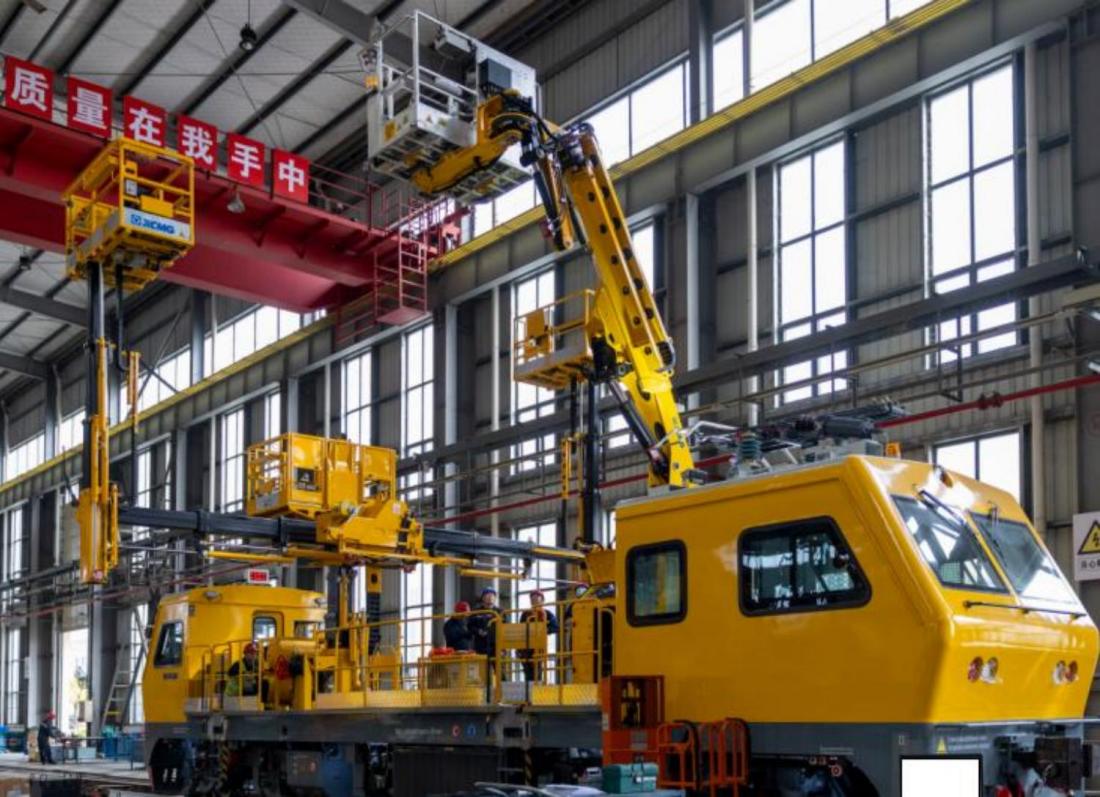
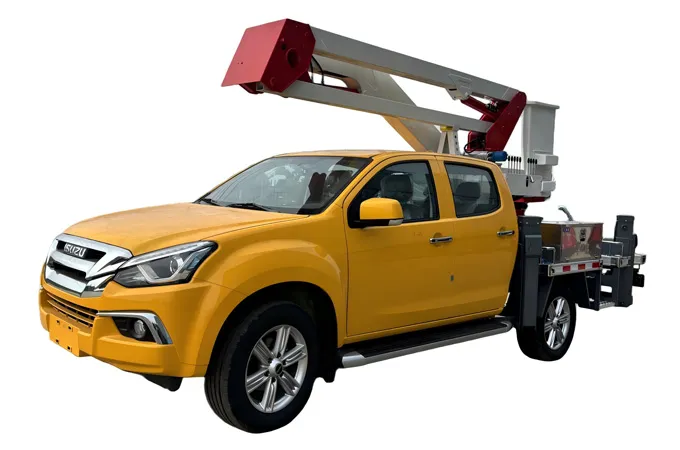
Previous Three-Platform Catenary Maintenance Vehicles (Pictures for Reference Only)
2.Main Technical Parameters
2.1 Applicable Environment
Ambient temperature | -30℃~ +50℃ |
Altitude | ≤2000 m |
Relative humidity | monthly average ≤90%, daily average ≤95% |
Maximum outer rail superelevation | 180 mm |
Maximum wind speed | ≤15 m/s |
The vehicle is suitable for night operation and capable of withstanding erosion from wind, sand, rain and snow.
2.2 Main Technical Parameters of the Vehicle
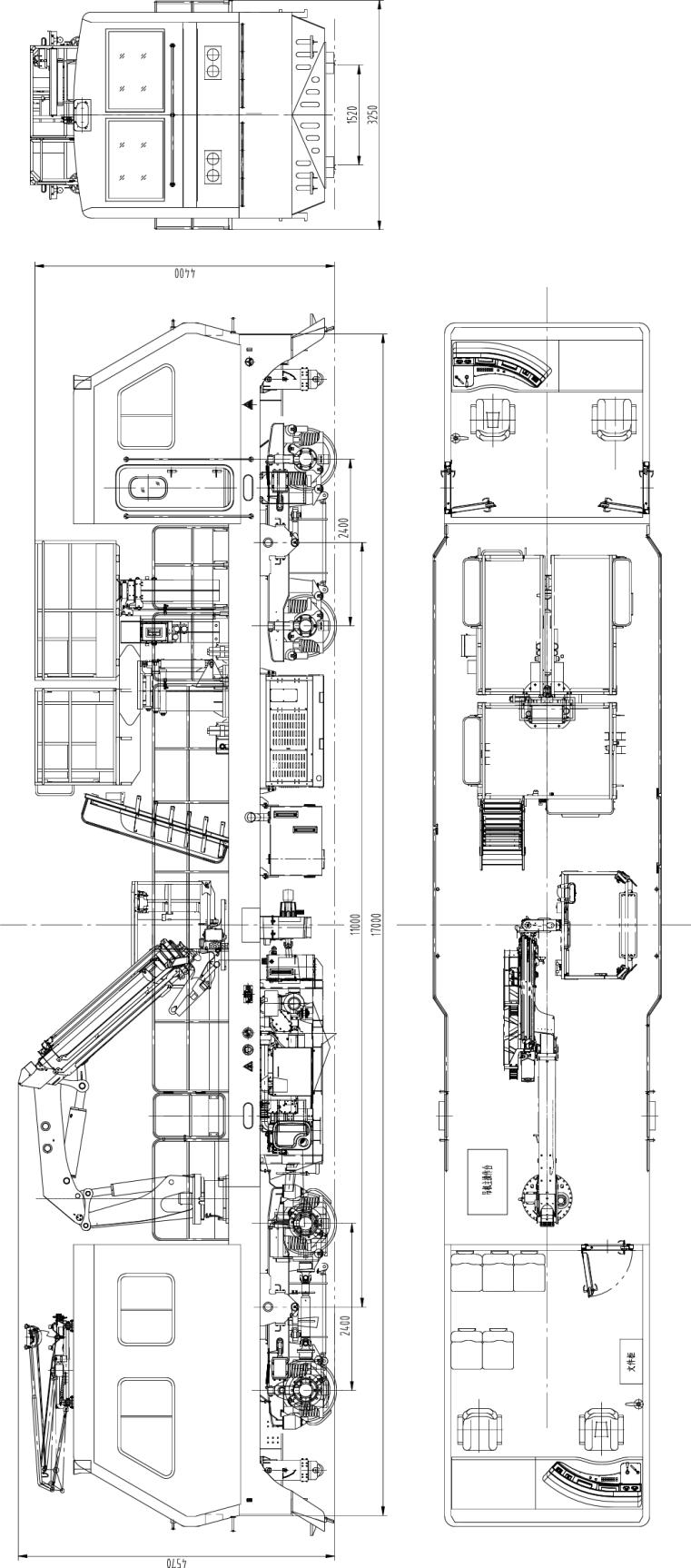
Gauge | 1520 mm |
Wheel diameter | 840 mm |
Axle arrangement | 2-B |
Wheelbase | 2400 mm |
Bogie center distance | 11000 mm |
Number of axles | 4 |
Minimum negotiable curve radius | 120 m (at 10 km/h) |
Maximum continuous running speed | 90 km/h |
Maximum coupled running speed | 100 km/h |
Engine | Electronic fuel injection diesel engine, meeting China Stage III emission standard |
Rated engine power | approx. 353 kW (480 PS) |
Fuel tank capacity | ≥ 800 L |
Transmission | Hydraulic transmission (with coasting self-lubricating system) |
Braking mode | Air brake and parking hand brake |
Air brake unit | JZ-7G |
Emergency braking distance | ≤ 400 m (single unit, straight and flat track, initial braking speed 80 km/h) |
Coupling device | Compliant with the existing requirements of O'z bekiston Temir Yo'llari |
Climbing capacity | 45‰ |
Overall dimensions | 17000 mm × 3250 mm × 4550 mm |
Self-weight | approx. 55 t |
3. Main Structure and Composition
The vehicle consists of the main frame, bogies, power unit and auxiliary systems, electrical system,
braking system, hydraulic system, front and rear driver’s cabs, three-platform working device, crane with detachable hanging basket, grounding pantograph and other components. All systems are arranged in functional modules with reserved maintenance spaces and passages, facilitating inspection and daily maintenance.
3.1 Main Frame
Adopting advanced welding technology as well as derusting and anti-corrosion processes. The side
beams are made of section steel, while the middle and end beams adopt box beam structures, meeting the transportation requirements for trailing trains. Draft gears are installed at both ends of the frame.
3.2 Bogie
The vehicle is equipped with two two-axle bogies. The bogie mainly consists of frame, wheelset, axle box, damping device, traction mechanism and foundation braking device. Safety connecting devices are arranged between car body and bogie frame, as well as between bogie frame and axle box & wheelset. No binding is required during vehicle hoisting or rerailing.
3.2.1 Bogie Frame The bogie frame is of all-steel welded structure.
3.2.2 Wheelset The wheelset adopts oil injection press-fitting technology, and the wheels are integrally rolled steel wheels.
3.2.3 Axle Box The axle box adopts rod positioning to realize three-dimensional relative movement of the wheelset against the bogie, improving running performance. An anti-overturning device is mounted on the axle box body to effectively prevent overturning accidents after vehicle derailment. Meanwhile, wheelset turning support interfaces are arranged on the axle box, meeting the requirements of wheelset turning without detaching wheels.
3.2.4 Damping Device A primary suspension with large static deflection is installed between the frame and axle box, and a secondary suspension with small static deflection is arranged between car body and bogie. The two-stage suspension design improves the vertical running stability of the rail vehicle and reduces dynamic force exerted on the track during operation.
3.2.5 Traction Mechanism It is used to transmit horizontal force between car body and bogie, and coordinate the rotation and transverse movement of the bogie relative to the car body.
3.2.6 Foundation Brake Safety hangers are fitted on foundation brake rods to ensure vehicle operation safety.
3.3 Power Unit and Auxiliary System
This vehicle is equipped with an electronically controlled engine and a horizontal hydraulic transmission box. The power unit and auxiliary systems are underslung, which maximizes the interior space for crew and construction operation, and also benefits vehicle sealing and noise reduction.
3.3.1 Diesel Engine
A WP12.480 electronically controlled water-cooled diesel engine manufactured by Weichai Power is adopted, complying with China Stage III emission standards. The main technical parameters of the diesel engine are as follows:
Model | WP12.480 |
Type | Water-cooled, vertical, in-line, 6-cylinder, four-stroke Intake mode: Turbocharged & intercooled |
Total displacement | 11.596 L |
Rated power | 353 kW (480 Ps) |
Rated speed | 2100 rpm |
Maximum torque | 1970 N·m |
Speed range of maximum torque | 1200~1500 rpm |
3.3.2 Hydraulic Transmission Gearbox The vehicle adopts imported horizontal hydraulic transmission
gearbox Voith T211 made in Germany, featuring hydraulic gear shifting. The gearbox is provided with a coasting function, which eliminates the need to disassemble the drive shaft during long-distance deadhead movement.
3.3.3 Auxiliary System
An integrated cooling device is adopted to integrate heat dissipation for boost air, coolant, transmission oil and hydraulic oil. It simplifies the structure, saves the underbody suspension space and facilitates maintenance.
3.4 Electrical System
A 24 V DC single-wire electrical system is adopted. The electrical system consists of an engine charging alternator, starting motor, lead-acid batteries, lighting equipment, instrument monitoring devices, signal and auxiliary devices, control units and other components. The vehicle is equipped with an external power socket, and a reserved radio antenna base is arranged on the roof. The control system adopts a digital microcomputer control system with data transmitted via bus communication. It features a high level of informatization and excellent controllability, and is provided with powerful self-diagnosis and fail-safe functions, as well as the recording function of pre-fault vehicle status and fault information. Vehicle status information is centrally displayed on a touch LCD screen with a clear and user-friendly interface. Headlights, auxiliary lights and marker lights are installed at both ends of the vehicle; remotely controlled rotating floodlights are mounted on the roof.
3.5 Braking System
The air braking system consists of JZ-7G air brake unit, air compressor, main air reservoir, check valve, safety valve, oil-water separator, air dryer, air pipelines, horn and sanding device. The foundation braking devices are mounted on the bogies with wheel tread braking adopted, and one set of hand brake device is equipped.
Stainless steel pipes are used for the main air pipeline, together with oil-water separators and air dryers, so as to improve the quality of compressed air.
3.6 Driver’s Cab
Front and rear driver’s cabs are arranged. Each cab is composed of a cab enclosure, standardized operation console, seats and other components. The front cab can accommodate 7 persons (including 2 driver seats), and the rear cab is equipped with 2 driver seats.
3.6.1 The cab enclosure adopts a section steel welded structure. The outer steel plates of the car body are manufactured by integral plate tensioning process with thermal insulation materials filled inside. The floor is of multi-layer structure coated with sound-absorbing damping glue, and covered with flame-retardant and oil-resistant floor leather. Hollow side windows are adopted, and the windshields are electric heating glass to ensure a wide field of vision, equipped with sunshade roller blinds.
3.6.2 Standardized operation consoles are arranged in both front and rear cabs, equipped with locomotive-type JZ-7G automatic brake valves. Only the handles of the automatic brake valve and independent brake valve are exposed on the console, presenting a concise and attractive layout. The driver’s seats are adjustable in tilt angle, longitudinal position and height.
3.6.3 Each driver’s cab is fitted with air conditioning, heating and ventilation systems, as well as horn control switches.
3.6.4 After all doors and windows are closed, the indoor noise shall not exceed 85dB(A).
3.6.5 The front cab is provided with a rear door. Steps and handrails for boarding and alighting are arranged on both sides behind the door with a guardrail height of 1100 mm. The rear cab is equipped with side doors on both sides, together with corresponding steps and handrails.
3.7 Hydraulic System
The hydraulic system mainly consists of two parts: the heat dissipation hydraulic system and the working hydraulic system.
3.8 Three-Platform Working Device
The three-platform device is composed of main columns, main platform, two telescopic booms, two side columns, side platforms, movable stairs, hydraulic cylinders, pipelines, lighting lamps and control elements. The side platforms can extend transversely and lift freely. The main platform and two side platforms can operate simultaneously to realize multi-level and three-dimensional construction. It supports multi-point coordinated or synchronous operation, which greatly improves the working efficiency.
3.8.1 Main Technical Parameters
Main Platform Maximum load capacity | 650 kg |
Height from platform floor to rail top | 3370 mm ~ 4200 mm |
Platform dimensions | 1700 mm × 1900 mm (Length × Width) |
Guardrail height | 1100 mm Side Platforms |
Maximum load capacity | 250 kg |
Height from platform floor to rail top | 3370 mm ~ 7300 mm |
Maximum working radius | 4100 mm (distance from platform to track center) |
Platform dimensions | 1800 mm × 900 mm (Length × Width) |
Guardrail height | 1100 mm |
3.8.2 Functions
3.8.2.1 The lateral travel of the two side platforms is limited to 500 mm. When a larger travel range is required, the override function shall be activated via the 0–1 selector switch to ensure operation safety on double-track lines.
3.8.2.2 Each of the three platforms is equipped with an emergency stop button. Pressing any button under emergency conditions will stop all mechanical movements.
3.8.2.3 The platforms are provided with low-speed travel buttons and speed selector switches.
3.8.2.4 Each platform is fitted with interfaces for electric and pneumatic tools.
3.8.2.5 Intercommunication devices are installed between working platforms and for personnel on the lower part to realize mutual communication.
3.8.2.6 Mechanical locking devices are provided for the two side platforms when they return to their original positions.
3.8.2.7 One set of grounding device is equipped.
3.9 Crane and Hanging Basket
The vehicle is equipped with a crane fitted with an electronic load limiting device and a radio remote control unit. The crane meets the following requirements:
| Maximum lifting moment | no less than 11 t·m |
| Maximum outreach | Transverse: no less than 8 m Vertical: no less than 11 m |
| Slewing angle | no less than 225° |
The crane is furnished with a detachable hanging basket, which is equipped with an electronic load limiter, electro-hydraulic horizontal adjusting device and sockets for electric tools.
Main technical parameters of the hanging basket are as follows:
| Length | no less than 800 mm |
| Width | no less than 1000 mm |
| Height | no less than 1100 mm |
Lifting capacity (2 workers plus tools and materials): no less than 350 kg 3.10.
3.10 Painting and Marking
The vehicle body is coated with high-grade polyurethane paint, featuring excellent weather resistance, high film hardness, as well as good resistance to acid, alkali, solvent and moisture. The standard color scheme adopts dark grey for the underframe, yellow and white for the car body, and yellow for working mechanisms. Customized color schemes can be designed in accordance with user requirements.
Vehicle markings comply with relevant regulations of the railway authority. Prominent instructions for operation and maintenance are arranged at corresponding positions to facilitate driver operation, fault maintenance and daily upkeep.
Lifting points and identification marks are provided on the vehicle.
3.11 Generator Set, Air Conditioner and Electric Heater
The vehicle is equipped with a diesel generator set with a rated power of approximately 10 kW. Air conditioners and electric heating devices are installed in the driver’s cabs to improve the working environment for operators.
Figure: Appearance and Layout Plan of Catenary Maintenance Vehicle