1. Overview
1.1 Project Introduction
The dual-purpose road-rail catenary maintenance vehicle is capable of running both on highways and railway tracks. It is driven by rubber tires under road travel mode and friction wheel propulsion under railway mode.
2. Design Basis & Standards
Design Basis: Technical Requirements for Dual-Purpose Road-Rail Catenary Maintenance Vehicle
Design Standards: The vehicle is designed mainly in accordance with Chinese National Standards, Enterprise Standards and Railway Standards; see the attached table for detailed referenced specifications.
Table 1 Main Referenced Standards
| No. | Category | Applicable Standard |
| 1 | Vehicle Body
| Steel Structure | GB/T 640: Ultrasonic Testing for Steel Forgings |
| 2 | QJ/LM 02141-2008 General Technical Specification for Product Coating |
| 3 | GB/T 8923 Rust Grade and Derusting Grade of Steel Surface Before Coating |
| 4 | GB/T 985.2 Recommended Groove for Submerged Arc Welding |
| 5 | JB/T 5000.3 General Technical Requirements for Heavy Machinery – Weldments |
| 6 | JB/T10750-2018 Tractors |
| 7 | JB/T 5000.5 General Technical Requirements for Heavy Machinery – Non-ferrous Castings |
| 8 | JB/T 5000.8 General Technical Requirements for Heavy Machinery – Forgings |
| 9 | JB/T 5000.9 General Technical Requirements for Heavy Machinery – Machined Parts |
| 10 | GB/T 1184 Geometrical Tolerances – Unspecified Tolerance Values |
| 11 | Interior & Main Equipment | JB/ZQ4000.9 General Assembly Technical Specifications |
| 12 | GB2349-1980 Hydraulic Cylinder Stroke Series |
| 13 | GB/T2878 Mounting Dimensions for Hydraulic Cylinders |
| 14 | Transmission System | GB /T 10095 Accuracy of Involute Spur Gears |
| 15 | JB/T 9050.1-1999 General Technical Specification for Cylindrical Reducers |
| 16 | GB 20891-2014 Emission Limits and Measurement Methods for Non-road Mobile Diesel Engines (China Stage Ⅲ & Ⅳ) |
| 17 | Electrical System | GB 4208 Classification of Degrees of Protection Provided by Enclosures |
| 18 | GB/T 27544-2011 Industrial Trucks – Electrical Requirements |
3. Design Principles
Design Principles for Dual-Purpose Road-Rail Catenary Maintenance Vehicle are as follows:
Adopt proven mature products and technologies for safety-oriented design to guarantee operator safety;
Inherit mature existing design schemes to improve vehicle reliability;
Simplify operating procedures to facilitate on-site operation and maintenance;
Ensure stable system performance, compact structure and attractive appearance while meeting all technical indicators.
4. Key Technical Specifications
4.1 Functional Requirements
4.1.1 Overall Functions
1. Railway Travel Function: Modified based on Sinotruk Howo ZZ2147N5227E1 off-road truck chassis. Friction guide devices are mounted on front and rear axles. Equipped with 4WD rubber tires and guiding wheels, the vehicle runs stably and at high speed along rails; rubber tires provide driving power while guiding wheels track the rail contour during rail travel.
2. Personnel & Material Cargo Compartment: A secondary frame is welded and installed on the modified chassis behind the original cab to form an enclosed cargo hold fitted with passenger seats, tool racks and material shelves for transporting crew, working tools and spare parts.
3. Working Function: A separable hydraulic crane plus hanging basket is installed at the vehicle rear after completing chassis and cargo compartment modification. The crane and basket can be rapidly assembled on-site for maintenance operations.
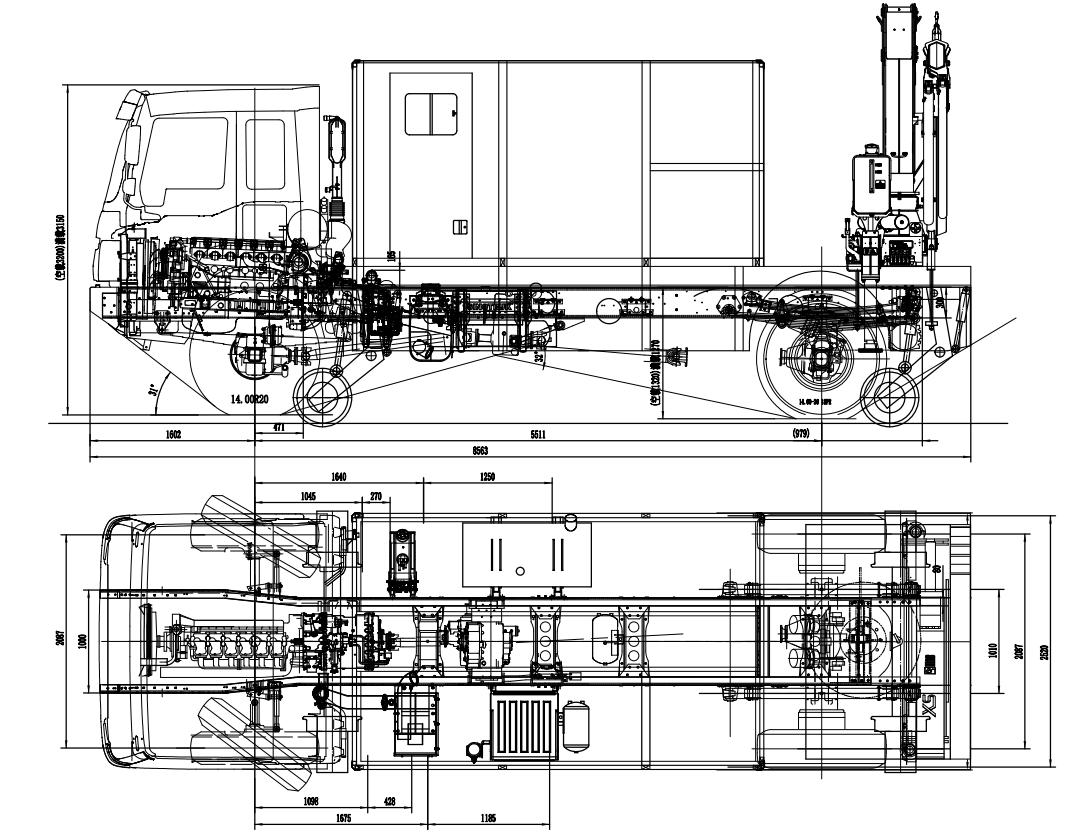
Figure: Schematic Diagram of Dual-Purpose Road-Rail Catenary Maintenance Vehicle
4.2 Core Technical Parameters
1. Applicable track gauge: 1520 mm
2. Maximum speed:
Rail travel: 15 km/h
Road travel: 90 km/h
3.Drive configuration: 4-wheel drive (4WD)
4.3 Ambient Operating Conditions
4.3.1 Natural Environment conditions
Terrain: flat ground
Climate: moderate continental climate
Altitude: ≤1000 m
Operating temperature: -40℃ ~ +50℃
Humidity: 0 ~ 100% RH
Average maximum wind speed: 4.5 m/s
Dust concentration: 10 mg/m³
Max soluble salt content in soil (chloride & sulfate): ≤0.1%
5. Overall Design of Dual-Purpose Road-Rail Catenary Maintenance Vehicle
5.1 Composition & General Layout
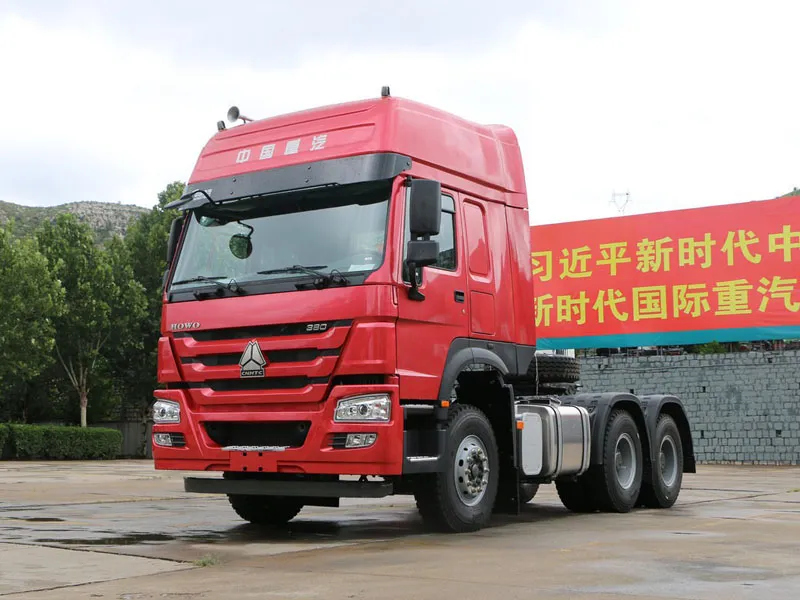
The vehicle is rebuilt on a specially modified Sinotruk Howo off-road truck chassis, consisting of body structure, cab, power system, electrical system and road-rail conversion guiding mechanism.
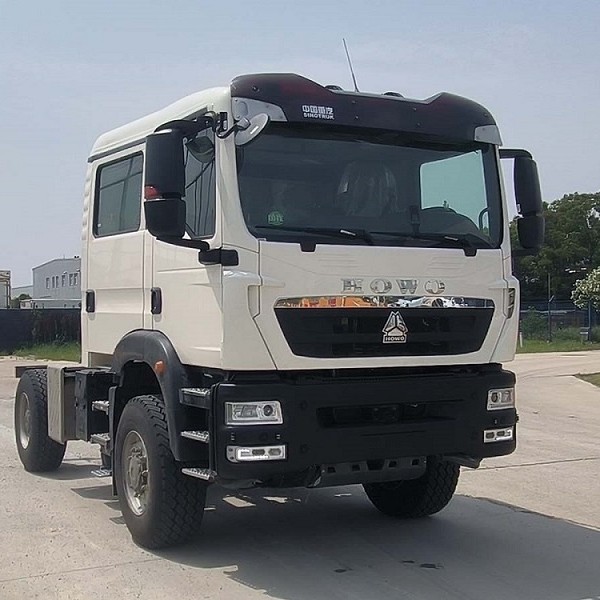
Figure 1 Chassis Of Dual Purpose Road Rail Catenary Maintenance Vehicle
The vehicle frame supports all onboard equipment. The electrical system consists of vehicle controller, wiring harness, lighting and video monitoring devices; an onboard power unit supplies power and signal control for the whole vehicle. The driver's cab provides operating space fitted with control levers and indicator lights. The friction guide system guides vehicle travelling on railway tracks.
Sinotruk Howo Base Chassis Parameters
| No. | Item Category | Item | Parameter | Remarks |
| 1 | Mass Parameter | Chassis Curb Weight (kg) | 820 |
|
| 2 | Maximum Permitted Load (kg) | 17000 |
|
| 3 | Performance Parameter | Maximum Speed (km/h) | 95 |
|
| 4 | Minimum Turning Diameter (m) | 21.5 |
|
| 5 | Maximum Gradeability (%) | 40 |
|
| 6 | Maximum Parking Gradient (%) | 20 |
|
| 7 | Fuel Tank Capacity (L) | 400 |
|
| 8 | Dimension Parameter | Overall L×W×H (mm), unladen | 8092×2520 (cab top) |
|
| 9 | Wheelbase (mm) | 5600 | Customizable |
| 10 | Cab | Type | HOWO Medium-Long Cab |
|
| 11 | Seating Capacity | 2 persons |
|
| 12 | Engine | Model | D10.31-50 |
|
| 13 | Rated Power(kW/rpm) | 228/1900 |
|
| 14 | Total Displacement(L) | 9.726 |
|
| 15 | Max Torque(N·m/rpm) | 1390/(1200–1500) |
|
| 16 | Clutch | Model | 430 Pull-type Diaphragm Spring Clutch |
|
| 17 | Operation Mode | Hydraulic Control with Pneumatic Booster |
|
| 18 | Transmission | Model | HW15710C |
|
| 19 | Forward Gear Ratios | 10.73,7.98,5.91,4.38,3.29,2.45,1.82,1.35,1.00,0.75 |
|
| 20 | Reverse Gear Ratios | 10.49,2.39 |
|
| 21 | Braking System | Rated Working Pressure(kPa) | 850 |
|
| 22 | Service Brake Type | Dual-circuit Air Brake |
|
| 23 | Brake Control | ABS |
|
| 24 | Parking Brake Type | Spring-loaded Air Release Brake |
|
| 25 | Auxiliary Brake | Engine Exhaust Brake |
|
The dual-purpose road-rail catenary maintenance vehicle adopts frame load-bearing construction, consisting of vehicle body, cab and drive assembly. Its overall specifications are listed in the table below.
Table 1 Main Technical Parameters of Dual-Purpose Road-Rail Catenary Maintenance Vehicle
| No. | Item | Parameter |
| 1 | Emission Standard | China National IV Engine |
| 2 | Operation Mode | Manual Driving |
| 3 | Highway Speed Range | 0~90km/h |
| 4 | Railway Speed Range | 0~15km/h |
| 5 | Rated Engine Power | 228kW |
| 6 | Cab | HOW Medium-Long Cab |
| 7 | Applicable Track Center Distance | 1520mm |
| 8 | Drive Form | 4WD |
| 9 | Transfer Case Model | ZQC1200 |
| 10 | Rear Axle Model | ST16 Single Rear Axle |
| 11 | Tyre Spec | 14.00R20 |
| 12 | Frame Type | Trapezoidal Frame |
| 13 | Basket Dimension | L800×W1000×H1100mm |
| 14 | Hydraulic Crane | Max Vertical Lifting Height ≥20m, 360° Full Rotation |
| 15 | Subframe | With Outrigger Mounts for Crane |
| 16 | Standard Fittings | Warning System, Safety Devices, Toolbox, Transmission Parts, Air Parking Brake, Power Windows, Air Conditioning |
5.2 Main Vehicle Components
5.2.1 Driver's Cab
(1) Overall Cab Composition
The cab features a well-designed, sturdy structure with excellent impact and compression resistance, as well as dust, heat and sound insulation performance to minimize driver injuries in collisions. A windshield wiper is fitted on the front windshield to guarantee driving safety. The cab is equipped with an interior rearview mirror, instrument console, air conditioner and hydraulic control devices to satisfy all operational requirements.
(2) Cab Control Devices
Forward/reverse control, braking, steering and functional buttons;
Front guide mechanism controls;
Monitoring display screen;
Parameter display for guiding devices.
(3) Cab Instrument Console
Instrument display layout and parameter configuration of dashboard.
(4) Rearview Mirrors
The vehicle is equipped with three rearview mirrors: two outer mirrors mounted on left and right sides of the cab plus one inner mirror installed at the front-middle inside the cabin. They reflect rear and lateral vehicle conditions in real time to broaden the driver’s field of vision effectively.
5.2.2 Lighting & Warning Devices
Warning lights and buzzers are installed on the vehicle top.
Two front LED headlights are available for running and working on tracks.
One revolving floodlight is mounted on the side of the cab.
Another two revolving floodlights are fitted on both sides of the vehicle body.
Two floodlights are arranged on the side wall of the working basket.
One lamp is equipped for illuminating the diesel engine compartment.
5.2.3 Video Monitoring System
Surveillance cameras are installed at four positions: front & rear friction guiding devices, vehicle rear end and hydraulic crane. Recorded videos can be copied to USB flash drives and played on PCs or laptops. The monitor supports picture switching and single-screen display via a handheld remote controller. These industrial-grade cameras come with infrared night vision to ensure normal operation after dark.
5.3 Power System
5.3.1 Power Unit
5.3.1.1 Function Composition and Layout
The dual-purpose road-rail catenary maintenance vehicle has two operating modes for highway and railway travel. It can carry out hoisting operations on railway tracks as well as run on ordinary highways. The vehicle is built based on Sinotruk HOWO 4×4 off-road chassis, with four rubber tires on front and rear axles plus front and rear friction guide wheels serving as driving wheels during rail operation.
5.4 Friction Rail Guiding Device
5.4.1 Layout and Functions of Guide Device
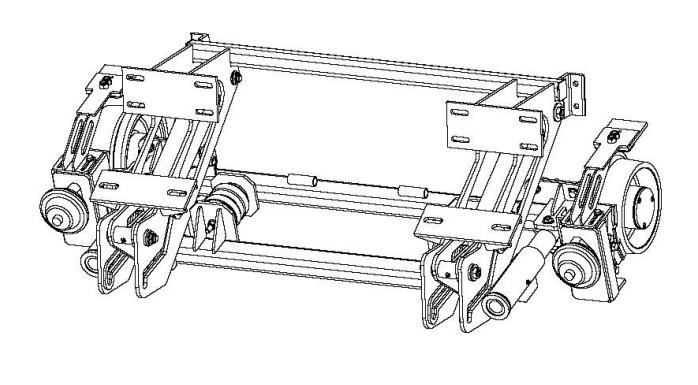
Retracted state of front and rear guide devices
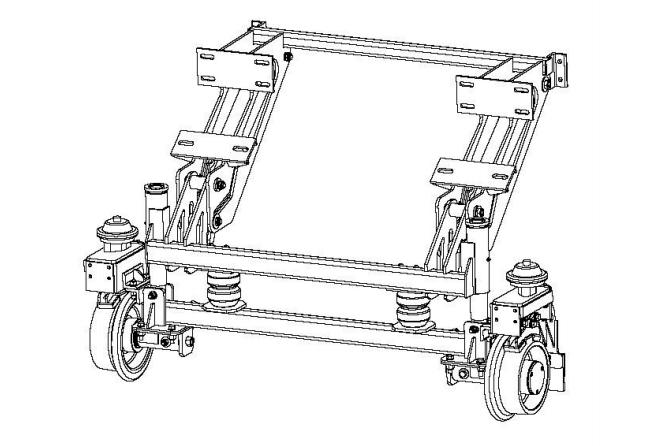
Working state of front and rear guide devices
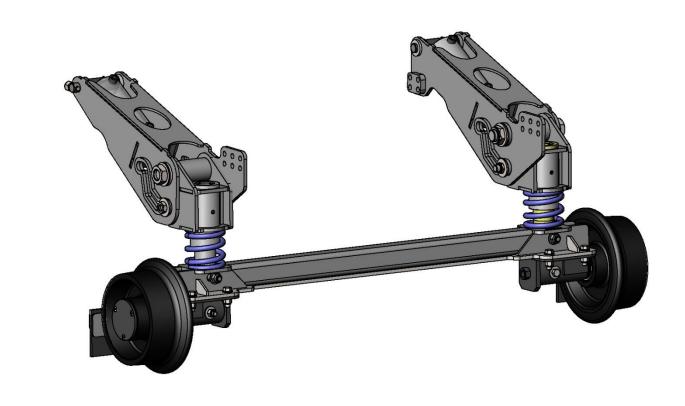
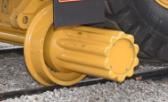
One set of friction guide wheel assembly is arranged at each end of the vehicle. The guide wheels constrain the vehicle to travel along rails and prevent derailment. Driven by hydraulic lift cylinders, the guide wheels can be lowered beneath rubber tires; the rubber tires drive the guide wheels to switch between road and rail modes. Position sensors are fitted on hydraulic cylinders to guarantee safe passage over sharp curves and turnouts without derailment. Each wheel set is equipped with two hydraulic cylinders equipped with double-acting hydraulic locks to avoid guide system failure caused by pipeline leakage or rupture under unexpected conditions.
5.4.2 Working Process of Friction Guide Device
The fixing plate of the friction guide unit is bolted to the vehicle body, and the cylinder supports are fastened onto the frame. Lifting and lowering of the guide device is realized via the extension and retraction of hydraulic cylinders.
5.5 Hydraulic Crane Assembly
A hydraulic crane and working basket are mounted at the rear of the dual-purpose road-rail catenary maintenance vehicle. The crane is fitted with stabilizers and an electronic load limiter to keep the vehicle stable under all operating conditions. Before crane operation, inspect the outrigger positions and adjust per three statuses: fully retracted, partially extended close to frame, fully spread to maximum ground span.
Crane Specifications:
Minimum rated lifting capacity: 15 t
Minimum maximum horizontal outreach: 20 m
Minimum maximum vertical lifting height: 22 m
Slewing range: 360° full rotation
Equipped with electronic load limiting and auto-leveling devices
Control & monitoring system enables emergency manual lowering of the crane upon hydraulic circuit breakdown
Rated lifting capacity allows personnel to work inside the movable basket at maximum operating radius
All crane movements are controllable via wireless remote control
A detachable working basket is supplied together with the crane for quick mounting and dismounting at the boom tip. The load limiter and leveling device shall remain functional throughout operation.
Basket Dimensions
Length: ≥800 mm
Width: ≥1000 mm
Height: ≥1100 mm
Rated loading capacity (2 operators plus tools & materials): ≥200 kg
Duplicated crane control panels are installed inside the working basket for on-spot operation.
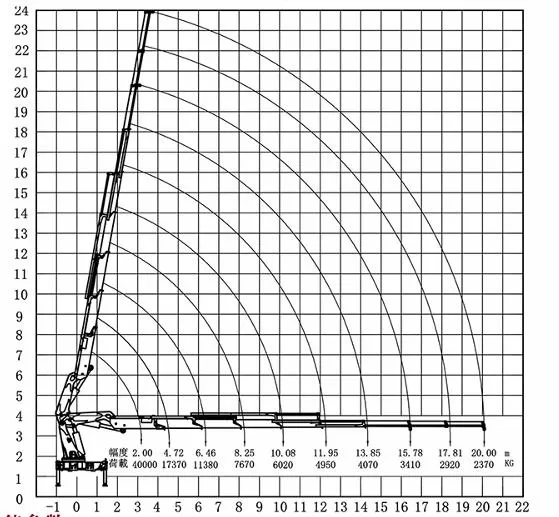
Hydraulic Crane
| No. | Item | Specification & Model | Remarks |
| 1 | Model | SQ35T |
|
| 2 | Rated Test Lifting Capacity (kg/m) | 17370/4.72 |
|
| 3 | Crane Dead Weight (kg) | 7940 |
|
| 4 | Installation Space (mm) | 1468 |
|
| 5 | Slewing Angle (°) | Continuous 360° rotation clockwise & counterclockwise |
|
| 6 | Maximum Boom Elevation Angle (°) | 80° |
|
| 7 | Rated Working Pressure (MPa) | 33 |
|
| 8 | Outrigger Span (mm) | 2210–8224 |
|
| 9 | Maximum Working Radius (mm) | 20000 |
|
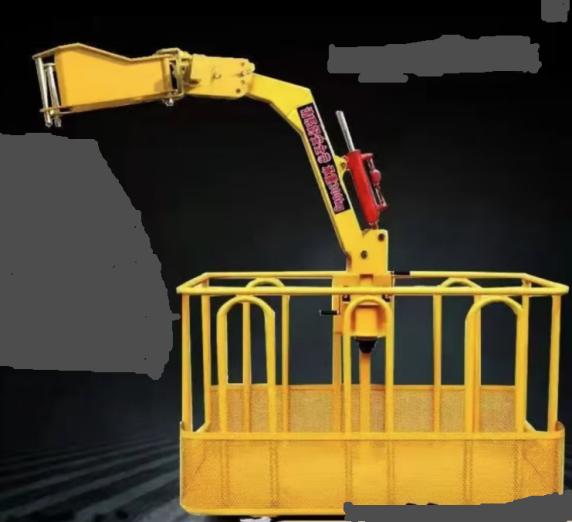
Figure: Photo of Working Basket
| No. | Item | Specification & Model | Remarks |
| 1 | Model | HTR110 |
|
| 2 | Overall Dimension | L800mm×W1000mm×H1100mm |
|
| 3 | Rated Load Capacity | ≥200 kg |
|
| 4 | Control Buttons | Consistent with vehicle-mounted control system; control mode switchable anytime |
|
| 5 | Safety Device | Electronic load limiting device |
|
| 6 | Level Control | Automatic leveling to keep basket horizontal, equipped with inclinometer |
|
5.6 Transport Cargo Compartment
A transport compartment is arranged behind the cab of the dual-purpose road-rail catenary maintenance vehicle, which is used to carry up to 8 operators and store necessary tools and materials. Adopting an integrated fully enclosed metal structure, the compartment features sound insulation and heat insulation performance. Its internal dimensions are 3500 mm in length, 2000 mm in width and 1800 mm in height. The transport compartment is divided into two independent spaces by a door-equipped internal partition. The exterior of the compartment is fitted with fixing devices for grounding rods and portable ladders. Meanwhile, the compartment is equipped with heating and ventilation systems, and internal lighting systems are installed in both separate spaces. In addition, an intercom system is configured in the transport compartment to enable real-time communication between operators and the driver. A rear access passage is reserved to allow entry into the cab from the transport compartment.
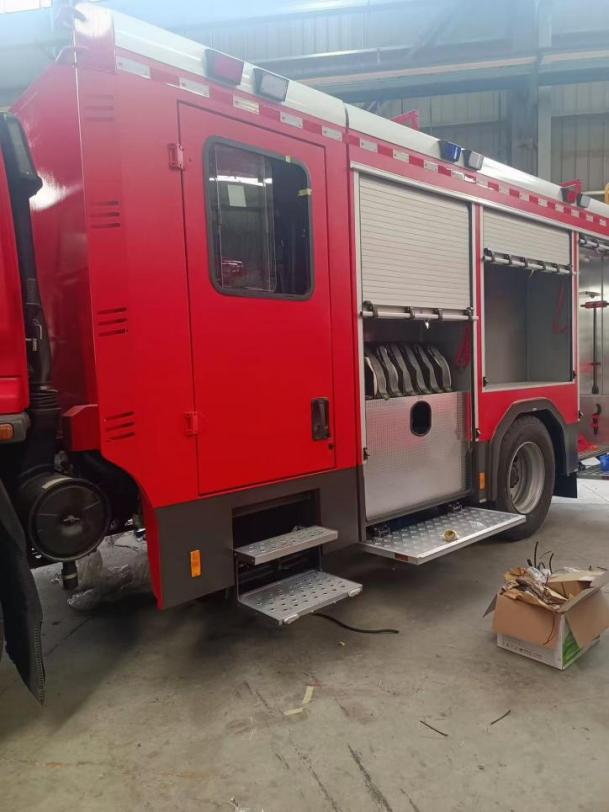
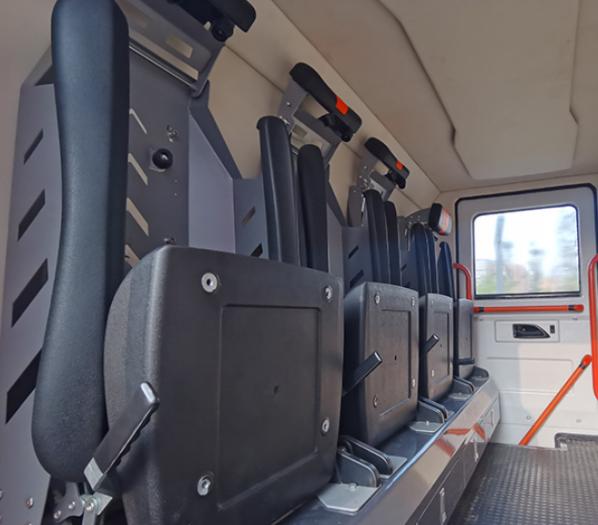
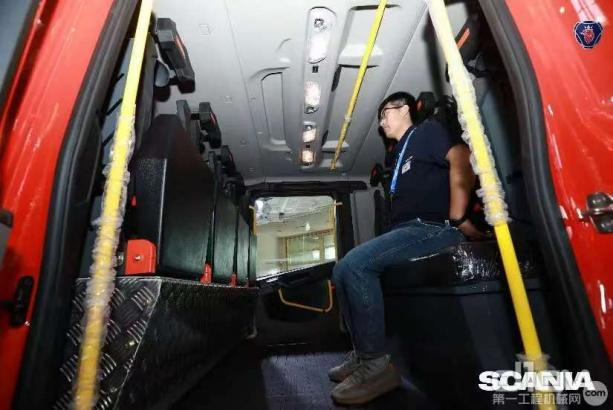
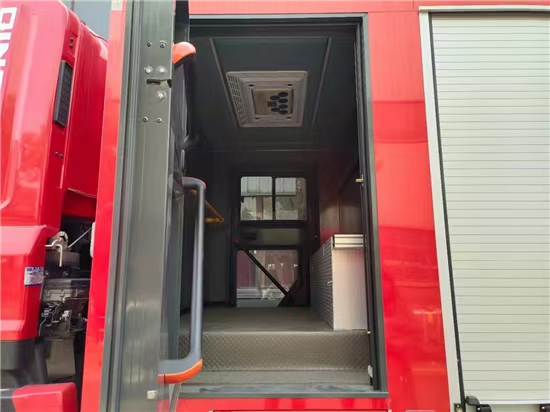
Figure: Internal and External Schematic of Transport Compartment
5.7 Auxiliary Frame
The auxiliary frame is fabricated by welding rectangular steel tubes and fastened to the chassis via connecting fittings to enhance overall load-bearing stability. The outriggers on both sides for the hydraulic crane are mounted on the auxiliary frame and shall be fully extended prior to crane operation.
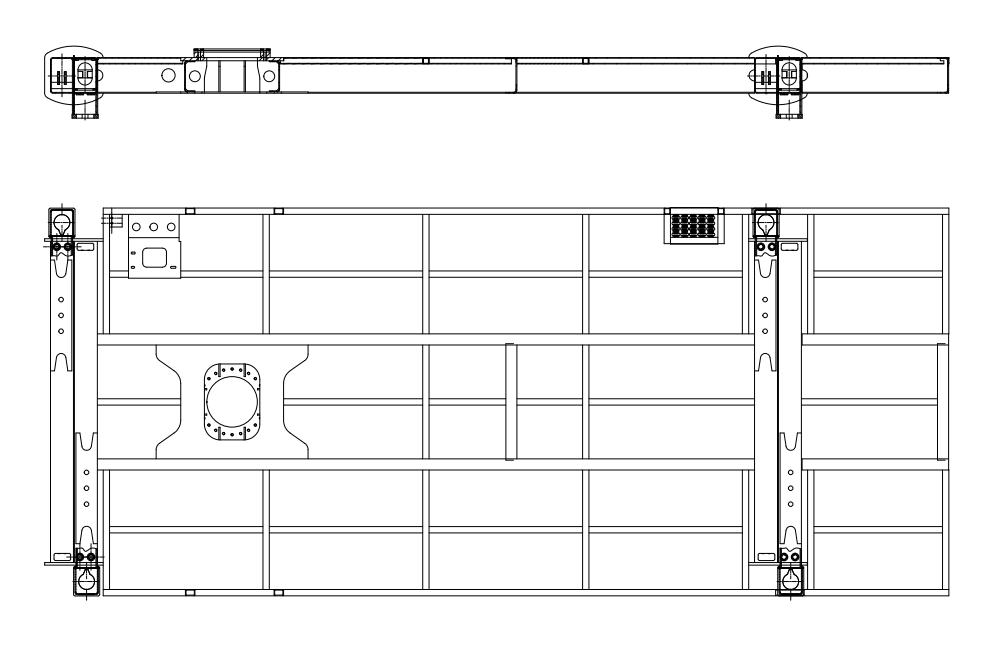
Figure: Schematic of Auxiliary Frame and Supporting Outriggers
6. Other Designs of Dual-Purpose Road-Rail Catenary Maintenance Vehicle
6. Other Designs of Dual-Purpose Road-Rail Catenary Maintenance Vehicle
6.1 Ergonomic Design
As the core human-machine interaction interface of the dual-purpose road-rail catenary maintenance vehicle, the instrument console directly reflects the overall operating state of the vehicle and is closely related to the safety of both operators and equipment. Therefore, the instrument console is designed based on ergonomic principles and human body dimension parameters with a clear and intuitive layout. The console features sufficient strength and rigidity to bear the load of instruments, pipelines and sundries, and can resist impact energy of a certain magnitude with excellent structural stability. It will not deform or fail under high-temperature conditions caused by solar radiation and engine residual heat, ensuring the long-term accuracy and stable operation of all instruments.
6.2 Packaging and Transportation Design
The dual-purpose road-rail catenary maintenance vehicle is delivered as a complete vehicle mainly via highway transportation. The whole vehicle is loaded in the factory workshop and fixed with steel wire ropes to prevent shaking and displacement during transportation. This ensures safe and puncture delivery of the vehicle to the destination.
6.3 Safety Design
The vehicle is equipped with multiple emergency stop buttons for safety protection. Two emergency stop buttons are installed on each side of the vehicle body (four in total). Additional emergency stop buttons are arranged at the bottom of the hydraulic crane, on the movable support, and on the wireless remote controller. In case of abnormal or dangerous operations, these buttons can immediately stop the vehicle and terminate all actions of the crane system.
7. Product Guarantee Design
7.1 Technical Documents
Complete sets of Chinese technical documents are delivered with the vehicle, including the factory qualification certificate, hydraulic schematic diagram, electrical schematic diagram, general assembly drawing, and operation manual.
7.2 Acceptance
1. Our experienced operators will be dispatched to the buyer's factory within the specified time to conduct the installation and commissioning of the dual-purpose road-rail catenary maintenance vehicle. All work including equipment design, full new manufacturing, packaging, installation and commissioning shall be undertaken by our side.
2. During equipment installation and commissioning, we provide free comprehensive technical training for the buyer's technical staff, operators and maintenance personnel covering equipment operation and daily maintenance.
3. The overall design, manufacturing, packaging, installation and commissioning of the product are completed by our team. Appropriate adjustments can be made to the equipment according to the buyer's process requirements and on-site working conditions.
4. After the final acceptance is qualified, both parties shall sign the acceptance report, and the product warranty period shall take effect officially.
7.3 After-sales Service
A full free after-sales warranty period of no less than one year is promised starting from the date of equipment delivery and put into use by the tenderer. We will respond actively to all demands raised by the buyer during the warranty period. In addition, lifelong maintenance and repair services will be provided after the expiration of the warranty period.